


Friday, September 11, 2026 - 12:36 PM
to Saturday, September 12, 2026 - 12:37 PM

12:36 PM - 12:37 PM See all dates and Times


Getting the height right on an adjustable standing desk turns a nice idea into a genuinely ergonomic workstation. Too high or too low and you’ll find yourself hunched, reaching, or constantly readjusting — all of which cancels the benefits of standing. This guide explains a repeatable measurement method, shows how to convert those measurements into desk frame and accessory settings, and walks through practical adjustments for a wide range of desk types from a Best Stand Up Desk to a roomy Standing L Desk. Follow these steps and you’ll set precise sit/stand presets that protect your wrists, neck and back.
Best Stand Up Desk: start with body-based measurements
The most reliable approach is to measure your body, not the desk. You need three baseline numbers:
- Seated elbow height: floor to underside of elbow while seated with good posture.
- Standing elbow height: floor to underside of elbow while standing straight, shoulders relaxed.
- Standing eye height: floor to center of your eyes while standing upright.
Use a tape measure and ask a colleague to read results, or take a photo against a wall for accuracy. Record each measurement in the same unit (centimeters or inches) and keep them handy for the next steps.
Best Standing Desk: calculate keyboard surface height precisely
Your keyboard should sit at or slightly below elbow height so wrists remain neutral. To calculate the correct desktop or tray height, subtract desktop thickness (or tray thickness) from your elbow measurement. Example: if your standing elbow height is 110 cm and the desktop is 2 cm thick, the equation is
110 − 2 = 108 cm
Digit-by-digit (to avoid mistakes): 110 minus 2 equals 108. That means the frame’s top surface (or the keyboard tray surface) should be about 108 cm from the floor when standing.
Vernal Standing Desk: a sample conversion with inches and centimeters
If you need inch equivalents, convert carefully. Continuing the example above, convert 108 cm to inches by dividing by 2.54 (since 1 inch = 2.54 cm). Do the division step-by-step:
2.54 × 42 = 106.68. Then 108 − 106.68 = 1.32. Now compute 1.32 ÷ 2.54 ≈ 0.5197. Add that to 42 gives 42.5197, which we round to 42.52 inches. So
108 cm ≈ 42.52 in
For the seated keyboard height calculation, do the same: if seated elbow height is 71 cm, then 71 − 2 = 69 cm for the desktop top, which converts as follows: 2.54 × 27 = 68.58, remainder 0.42; 0.42 ÷ 2.54 ≈ 0.165; so 27 + 0.165 = 27.165 inches ≈ 27.17 in. (If you use a keyboard tray, measure the tray surface instead of the desktop.)
Height Adjustable Desk: factor in desktop thickness and trays
Desktops vary. Thick wood or composite tops change the math. Example rule of thumb:
- If desktop thickness = 2 cm, subtract 2 cm from elbow height to get frame or tray height.
- If you use a keyboard tray that mounts underneath, measure the tray surface at full extension and set the tray to match elbow height directly — no desktop subtraction needed.
Always measure final height with your shoes and anti-fatigue mat in place so the numbers reflect real use conditions.
Electric Adjustable Desk: program presets and test under load
Once you have the two key values — seated keyboard height and standing keyboard height — program them into your electric desk presets. If you have an electric adjustable desk, set one preset for sitting and one for standing. Test each preset with typical equipment loaded (monitors, laptop dock, speakers) because weight can slightly affect final height. Make small adjustments and re-save presets until the keyboard height and monitor vertical position feel natural.
Standing L Desk: coordinate dual-surface setups
For L-shaped configurations, measurements are the same but applied to two zones. Choose one zone as your primary typing surface and calculate the keyboard height there. If the return wing carries a different thickness or purpose (for sketching, holding reference materials), calculate its height separately. If the wings are linked to the same frame, ensure the frame’s maximum and minimum heights accommodate both needs — otherwise use independent legs or an accessory shelf to get the right ergonomic result.
Executive Standing Desks and Standing Desk Wood: account for mass and stability
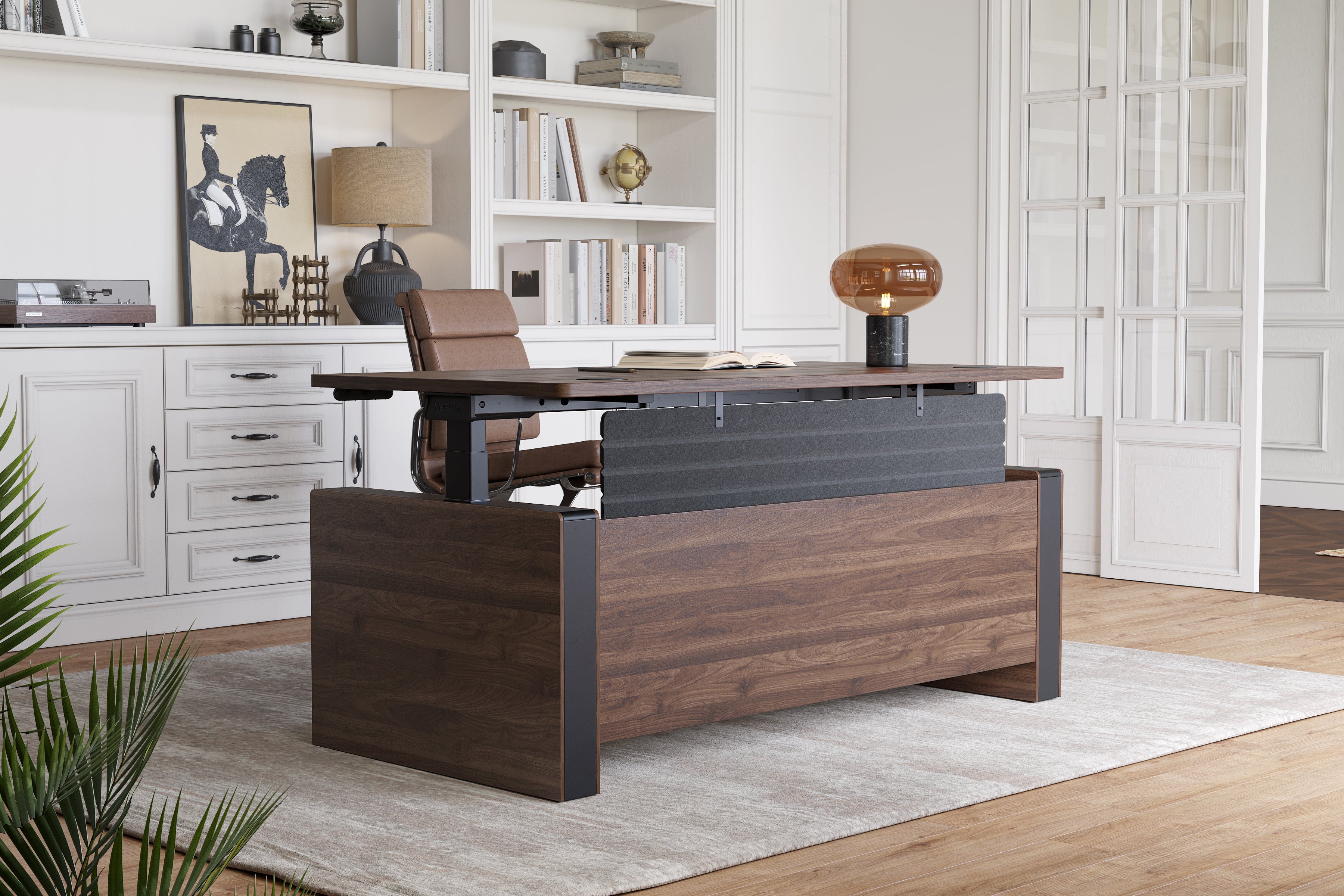
Large executive tops or thick standing desk wood surfaces change the mechanical behavior. Heavier tops can slightly compress or shift under load and may require frames rated for the additional mass. When you calculate target heights for heavy wooden tops, verify the manufacturer’s rated height range and load capacity before finalizing settings. If the top is unusually thick, you may need a few extra millimeters of subtraction in your initial math to compensate for mount hardware or protective pads.
Practical monitor height conversion and placement
Monitor placement is the other crucial element. Aim for the top third of the screen at or slightly below eye level when standing. If your standing eye height is 175 cm and your monitor’s visible height is 30 cm, the top of the monitor should be roughly eye height minus a small collar allowance (5–15 mm). A practical formula:
Monitor top height = Standing eye height − 1.5–3 cm (visual comfort)
Use an articulated monitor arm where possible — it decouples screen height from desk height and makes conversions painless.
Vernal Reviews: check real-world presets and stability notes
Before buying a model, consult user reports for real-world behavior under load. Vernal reviews and community feedback often reveal whether presets remain accurate after months of use and how a frame handles large wooden tops. Stability under typing and tablet pressure is essential for designers and people who use drawing tablets. Look for comments about wobble, motor strain, and how precisely a desk returns to saved heights.
Fine-tuning and comfort checks
After programming presets, perform comfort checks:
- With hands on keyboard, wrists should be neutral; shoulders relaxed.
- Eyes should land near the top third of the screen without tilting your head forward.
- When standing, distribute weight and use an anti-fatigue mat; do not lock knees.
If you feel strain, re-measure and adjust in 1 cm (or 1/4 in) increments — small changes matter.
Common pitfalls and how to avoid them
Watch for these errors:
- Measuring with the wrong shoes on — always measure in the footwear you’ll wear while working.
- Forgetting mat thickness — anti-fatigue mats raise your standing surface; subtract mat thickness from standing measurements if you measure without the mat in place.
- Relying on quick guesses — take the time to measure both seated and standing elbow heights precisely.
Conclusion: convert once, use comfortably for years
Converting body measurements into desk settings is a small upfront investment with big long-term returns. Whether you’re setting up a Best Stand Up Desk, programming presets on an Electric Adjustable Desk, or fitting a heavy Standing Desk Wood top to a frame, the same measurement rules apply: measure elbow and eye heights precisely, subtract desktop or mat thickness, convert units carefully when needed, and save presets. Run a quick comfort check and consult user feedback like Vernal reviews if you need model-specific insight. With this method you’ll have accurate sit/stand heights that fit your body — and a workstation that supports posture, productivity and comfort for years to come.
